Major Arcana
Death Tarot Card Meaning: Upright, Reversed & In Love
The Death tarot card almost never means literal death. It's the card of endings, transformation and rebirth — here's the full Death tarot card meaning, upright and reversed, in love, career and as advice.
Let’s clear up the big one first: the Death tarot card almost never means physical death. Ask any tarot reader — it’s the most misunderstood card by people who don’t read tarot, and the one most readers are quietly fond of. The real meaning of the Death card is transformation, the close of one chapter so another can begin. Among the tarot card meanings in the Major Arcana, it’s also one of the most transformative — the card of death and rebirth.
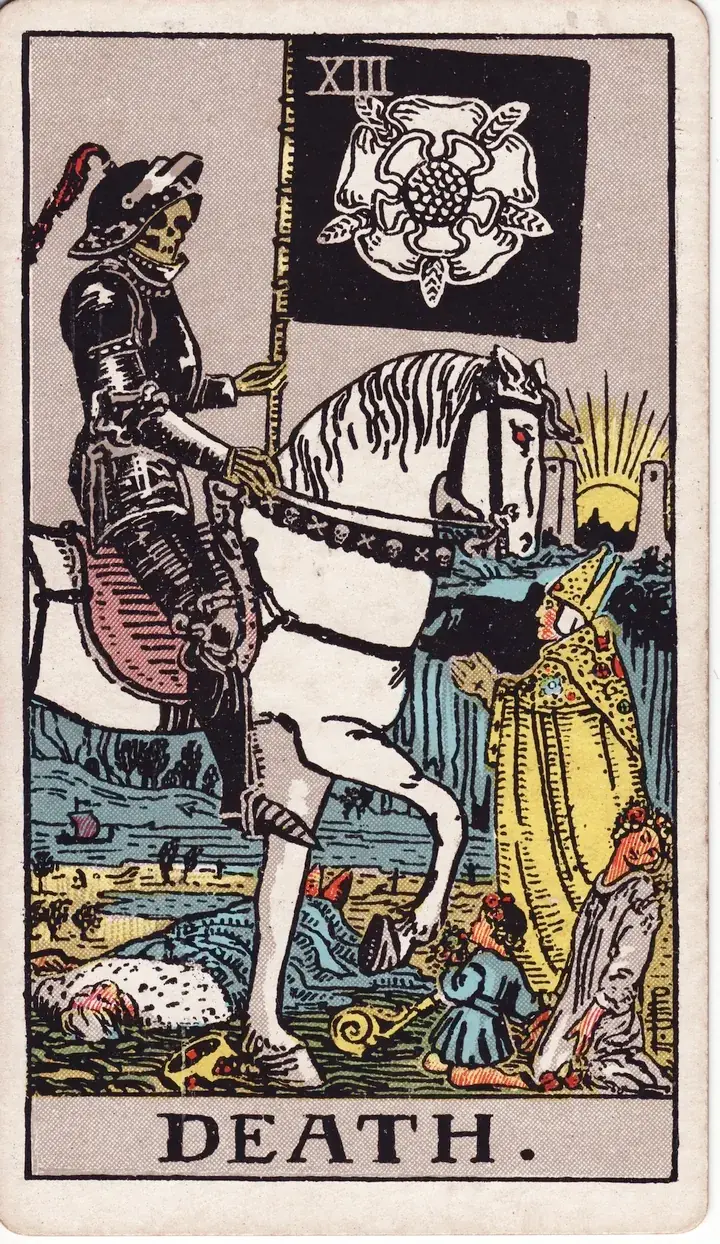
Death is card XIII, the thirteenth arcanum in the Rider-Waite-Smith tarot deck. In the classic image, an armoured skeleton rides forward on a white horse, carrying a black banner with a white rose. The figure passes a king, a bishop, a mother and a child — everyone meets it differently. In the distance, between two pale columns at the horizon, the sun is rising over a river. That detail matters. Death is an ending with a morning attached — fear resolved into change and transformation. Upright or reversed, the imagery never points to actual death.
What the Death card really means
Death marks the kind of close that isn’t optional. Not “you should change” — more like “this has already finished, and you’re being asked to let it.” A phase of life, a version of yourself, a way of doing things that has simply run its course. The deeper death meaning is rebirth on the other side of a chapter you didn’t quite want to finish.
It can feel heavy, because endings do. But the card’s deeper message is that holding on to what’s already over costs you far more than letting it close. People fear this card on sight; readers learn to greet it like a quiet teacher.
Death keywords
Upright: endings, transformation, transition, release, rebirth, new beginning, a clean break, personal transformation, a chapter closing for good.
Reversed: resisting an ending, stagnation, clinging, a transition stalled, fear of change, holding on past expiry.
Death upright — meaning
Upright, Death is a definite close — a chapter finishing for good. The discomfort usually comes from resisting it rather than from the change itself. When the card appears upright, its advice is unglamorous and kind: stop reviving what’s finished. Let it be finished. Something is waiting on the other side of that — often a new beginning that genuinely fits you, where the last one no longer did.
Death upright also signals a big change you’ve been sensing but not yet naming. The reading invites you to name it. Once you name a transition, you can begin to move through it instead of being pulled along by it. The parts of your life that no longer serve you go first — that’s the kindness hidden in the card of death.
Death reversed
Reversed, Death is the change you won’t let happen. You’re holding the door shut on something that needs to close — and the result is a kind of limbo, where nothing finishes and so nothing can begin. When something has stopped serving you and you’re refusing the closure, this is the card that surfaces. Held long enough, that refusal keeps you locked in something unfulfilling far longer than the actual loss would.
When the card appears reversed, it is gentle but firm: the longer you hold on, the longer the in-between lasts. The need to let go is the whole reading. It may also surface in any spread where you’re clinging — a job, a relationship, an old self-image — and the card reversed names the cling rather than condemning it. Often it’s pointing at something you’ve been avoiding for months. Reversed brings into focus the difficult to let go side of any major transition.
Death in love and relationships
Upright: a real transition in a relationship — sometimes a close, but just as often a transformation. A relationship sheds an old dynamic and becomes something new. If you’re single, the Death card in a reading can mark the genuine closing of a chapter — finally being done with someone, in a way you weren’t before. Where The Lovers card opens a new bond, Death honestly closes one that no longer serves.
In a love tarot reading, the Death card is rarely the disaster people fear when they first see it. Most often it names the relationship that both people already know is finished but neither has said out loud yet.
Reversed: holding on. Staying in something out of habit or fear of the gap afterwards. The card asks, plainly: is this still alive, or are you keeping it on life support?
Death in career and finances
Upright: the end of a professional chapter — a role, a path, an identity you’d outgrown. Endings here tend to be the start of something better suited. A Death card in a reading about your career is rarely about failure; it’s about a fit that’s quietly closed.
Reversed: staying somewhere past its expiry date because leaving feels like too much. The stagnation is the cost of not choosing. On a career change specifically, Death reversed can flag spending habits or financial patterns that you’ve outgrown but keep repeating — a small personal transformation you’ve quietly been refusing.
Death and health
Death almost never refers to physical death in a reading — it’s a metaphor, not a forecast. Where the card touches health, it tends to point to the close of a habit or a state: a regime that’s run its course, a chronic worry being released, an old pattern of stress finally breaking. If a real health question is on your mind, see a doctor — not a tarot card.
Yes or no answer
As advice, Death says: let it end. Grieve it if you need to — then turn toward the morning. You cannot start the next thing while the last thing is still half-open. As a yes/no card, the Death tarot meaning is a no to “can this stay as it is?” — and a yes to “is it time for something new?”
Death and the end of an old self
In modern readings, what the Death card represents is often what people call ego death — the close of an identity you’ve been performing, the version of yourself you outgrew but kept defending. The card invites you to let that older self go without ceremony, the way you’d return a borrowed coat. Letting go of the past is rarely tidy. What stays after is usually closer to who you actually are now. That’s the end of old patterns the card teaches: close one door, and a new can begin to open on the other side.
Death and the Rider-Waite-Smith imagery
The Death tarot card meanings drawn from the Rider-Waite imagery are remarkably specific. The white horse is purity and clarity moving through the inevitable. The black banner with the white rose says: yes, this is hard, and something fresh is being carried forward. The two towers on the horizon echo the Moon card — passage between worlds. The rising sun behind everything is the card’s quiet promise: morning, even here.
Among the Major Arcana, this Major Arcana card is the bridge between the Hanged Man (the pause before letting go) and Temperance (the new balance that follows). Like the Tower, it announces that changes are happening whether or not you’ve named them yet. In the Minor Arcana, the suit of Swords often anticipates a Death-card moment — the mind preparing for what the heart will then have to release.
How readers approach this card in a spread
Most experienced tarot readers don’t soften the card of transformation — they sit with the person and name what’s already finishing. A skilled card reader uses it as a doorway, not a diagnosis: what is closing, what wants to be born next, what part of you has already moved on while the rest of you is still catching up. The card in a tarot reading is asking you to participate in the change, not just receive it.
If you’d like to pull a free tarot card yourself and meet Death without a reader between you and the card, that’s a fair way to start. Sit with the imagery for a minute before reaching for a meaning. The card tends to speak before the words do.
When the Death card brings up a real question
Endings are the hardest moments to navigate alone — there’s grief mixed into them, and grief clouds judgement. If a chapter is closing and you’re not sure how to step through it, a tarot reading with an honest reader can help you find the doorway in the dark.
If you’d like to learn to read the cards yourself and sit with the Death card in your own practice, our beginner’s guide to reading tarot covers spreads, shuffling, and how to interpret each card without needing to memorise a long list.
In one line
The Death tarot card almost never means death. It means something is genuinely over — death and rebirth turning at the same time — and that the sun is already rising on whatever comes next.
For a deeper sense of how this card sits inside the rest of the deck, see how it pairs with The Tower (sudden change) and The Star (the calm that follows the storm) in our Major Arcana tarot card guide.
For reflection and entertainment — tarot is not a prediction of outcomes, and not a substitute for professional advice. 18+.